Solar Farm Intelligence: SCADA Systems for Commercial-Scale Renewable Energy
How CSI designed and deployed a complete supervisory control and data acquisition system for a portfolio of commercial solar farms — giving operators real-time visibility, remote control, and regulatory-compliant monitoring across facilities generating up to 10 MW each
Industry
Energy & Renewables
Service
Full System Design & Integration
Platform
Siemens S7-400 / WinCC SCADA
Capacity
Up to 10 MW per farm
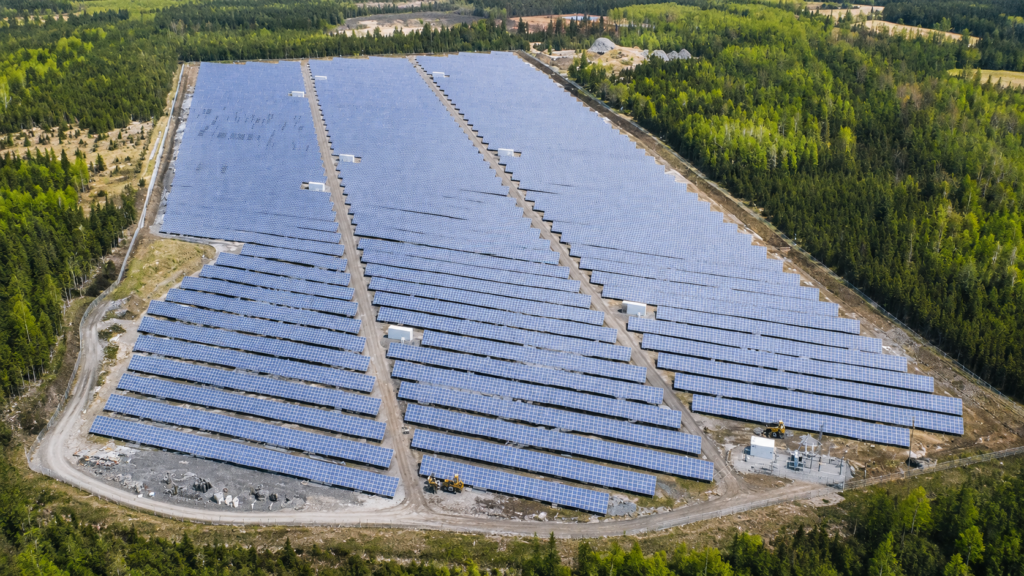
A major Canadian solar energy company was building out a portfolio of commercial green field solar farms across Ontario, each generating up to 10 MW. Every farm needed a SCADA system capable of monitoring and controlling inverters, recombiner boxes, weather stations, medium-voltage switchgear, and substation equipment — all while meeting Hydro One’s strict interconnection and reporting requirements. The system also had to support remote access from the company’s central operations centre, generate automated performance reports, and provide power factor control at the point of common coupling. With multiple farms planned for deployment within months of each other, the company needed a SCADA platform that was both comprehensive enough for regulatory compliance and repeatable enough to scale across sites.
Beyond the control and monitoring requirements, the customer also needed a way to evaluate whether each farm was performing to its full potential. That meant the SCADA system couldn’t just report what was happening — it had to compare actual output against a theoretical model of what the farm should be producing under the current conditions.
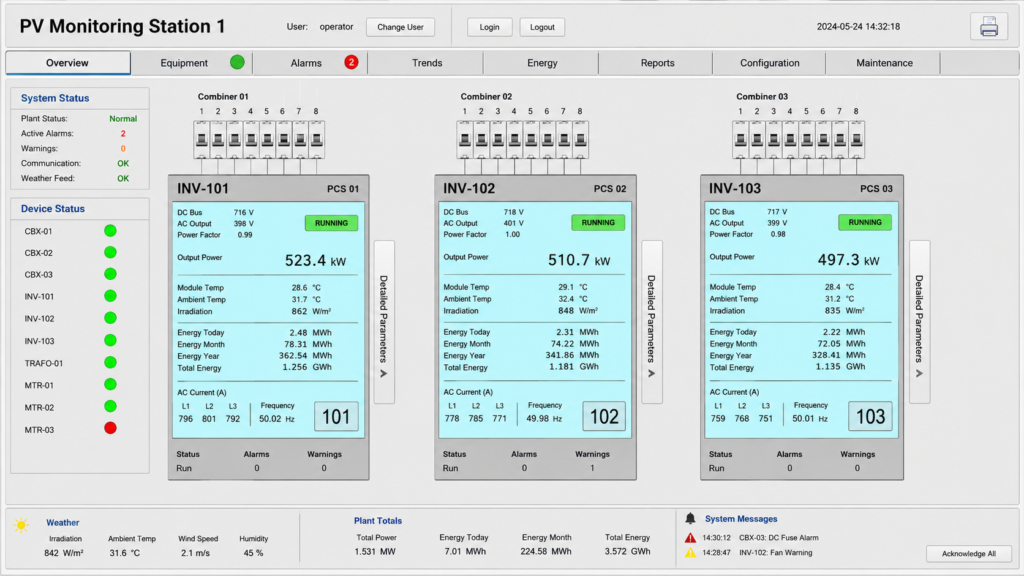
CSI designed and developed the complete SCADA platform for the solar farm portfolio, built on a Siemens S7-400 PLC and WinCC SCADA software. The PLC polls data from inverter stations, recombiner boxes, communication boxes, and Schneider switchgear equipment via TCP/IP Modbus, organizing all field data into structured data blocks for efficient HMI connectivity.
The WinCC SCADA layer delivers a comprehensive set of operator screens covering plant overview with real-time meteorological data, MV distribution and switchgear status with breaker control, detailed inverter station monitoring with per-inverter and per-recombiner-box diagnostics, trend displays with both instantaneous and five-minute averaged data, alarm management with email notification, and bar graph comparisons of energy production, irradiance, and performance ratio across daily, monthly, and yearly timeframes.
CSI also implemented automated CSV data export, performance ratio calculations, CO₂ emissions tracking, and web-based remote access via WinCC Web Navigator — giving the operations centre in Guelph full remote monitoring and control without requiring on-site presence. The system was designed to comply with Hydro One’s distributed generation interconnection requirements, including power factor control operating independently from the SCADA through dedicated PLC logic.
A key differentiator of CSI’s SCADA platform was the development of a theoretical performance model for each farm. CSI built models that calculated expected energy output based on sky conditions, weather type, time of year, solar angle, and irradiance — then compared real-time actual production against the theoretical baseline to identify underperformance at the farm, inverter station, or individual inverter level. Building an accurate model required working directly with sensor vendors to create and reconfigure monitoring equipment to achieve the precision needed for meaningful comparison — off-the-shelf sensor configurations weren’t accurate enough to support the analysis the customer required.

CSI worked with the engineering and construction firm managing the solar farm builds to finalize the scope of work, providing all supporting documentation for project control. The SCADA system was designed to be deployable across multiple farm sites with minimal reconfiguration — each farm shares the same architecture of eight inverter stations, weather monitoring, and substation integration, with site-specific I/O mapping handled through structured data blocks.
The SCADA platform was deployed across five commercial solar farms, giving the customer centralized visibility across their entire portfolio. The theoretical performance model — comparing actual output against predicted generation based on weather, sky conditions, and time of year — allowed operators to pinpoint underperforming equipment quickly rather than waiting for end-of-month production reports to reveal losses. The repeatable architecture allowed all five farms to be brought online efficiently without redesigning the control system for each site.
Per-farm monitoring capacity
Solar farms deployed
Theoretical vs. actual comparison
Tell us about your project, and we’ll walk you through how we’d approach it