From Mitsubishi to Siemens: PLC Migration and Line Upgrades for a Plastics Extruder
How CSI replaced the legacy control system on a plastics extrusion line with a modern Siemens PLC platform — while simultaneously adding a new calibrator control system and upgrading oven temperature control to ten independent zones.
Industry
Plastics
Service
Migrations & Retrofits
Platform
Siemens S7 PLC
Line
Extrusion Line 4
The Mitsubishi platform was due for replacement, but the customer also needed two significant upgrades at the same time: integration of a new calibrator system with six thermoregulated water zones and eight vacuum zones, and an overhaul of the oven controls from their existing configuration to ten independent closed-loop PID temperature zones. The entire changeover had to be completed within a two-week shutdown window — meaning CSI needed to reverse-engineer the existing system, build and test the new one, and have the line back in production before the window closed.
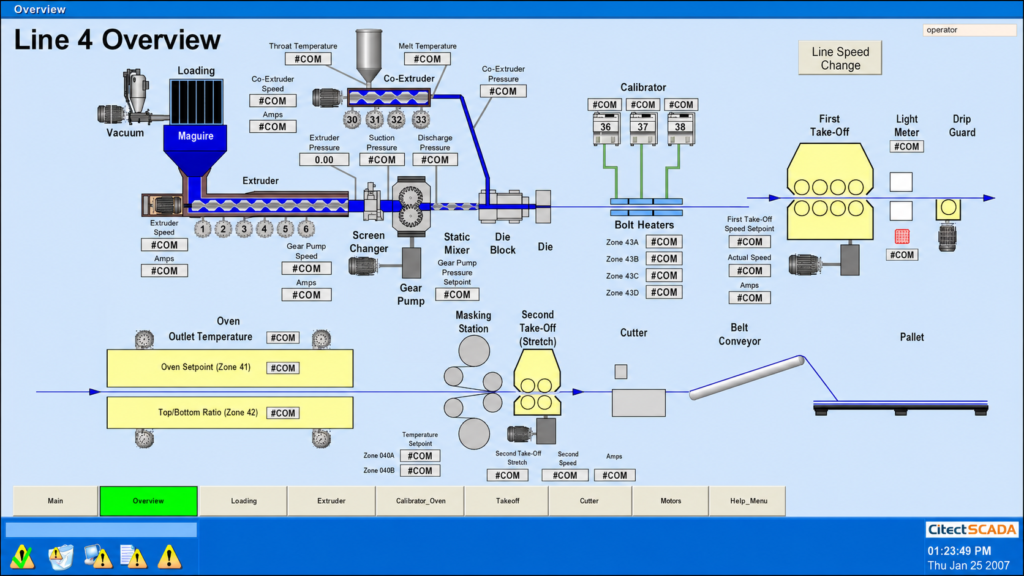
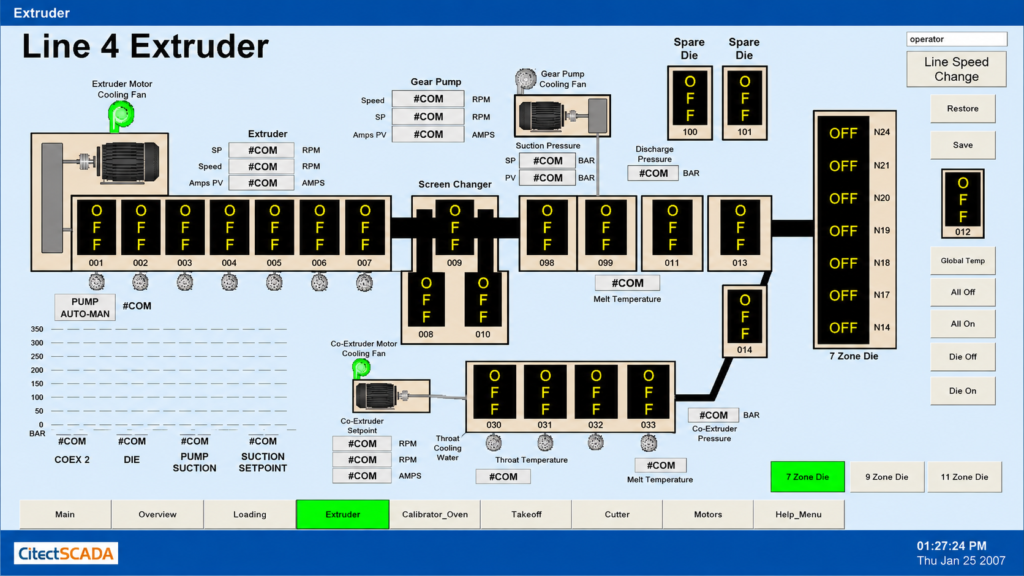
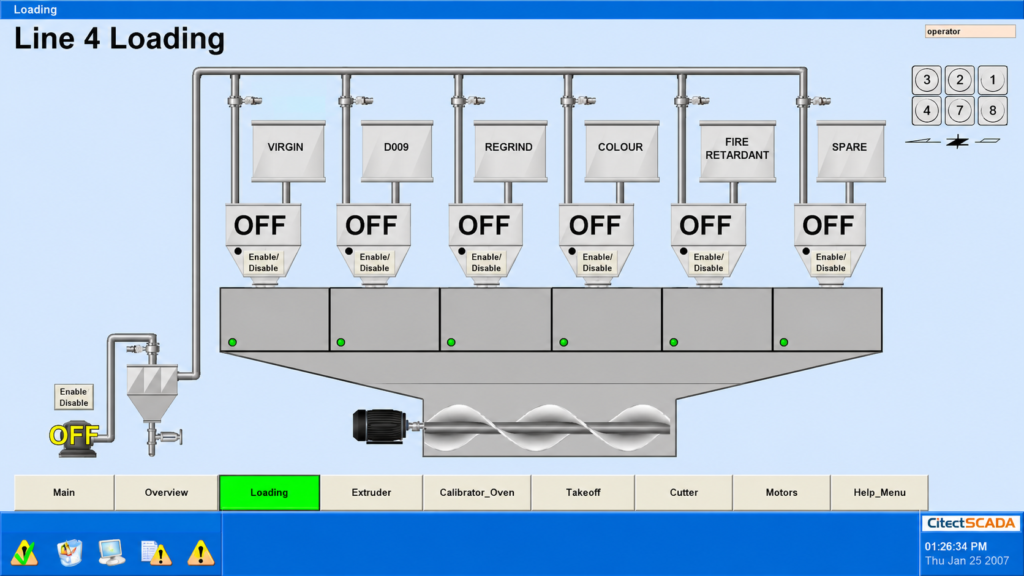
CSI replaced the Mitsubishi PLC with a new Siemens PLC controller, rewiring all existing I/O points and reprogramming the system to match the extruder’s existing functionality exactly. The existing HMI was retained and reprogrammed to communicate with the new Siemens controller — all screen displays and operator workflows stayed the same.
For the calibrator upgrade, CSI supplied a separate Siemens PLC and HMI station in its own electrical control cabinet, programmed for independent operation of six water zone thermoregulation circuits and eight vacuum zone controls with safety interlocks. This standalone calibrator controller connects back to the main extruder PLC via PROFIBUS for centralized monitoring and control.
The oven upgrade added ten independent closed-loop temperature control zones — five for top heaters and five for bottom heaters — each with its own setpoint and feedback loop, giving operators precise control over the thermal profile across the full length of the oven section.
The centerpiece of the upgrade was the precision temperature control through the oven section. Using Siemens components and a specially developed algorithm, CSI achieved temperature accuracy of ±0.5°C through the entire extrusion process — a step change from the previous system’s capability. CSI also developed a custom algorithm to maintain consistent output pressure into the die by dynamically adjusting for line speed variations throughout the extrusion process, ensuring uniform product quality regardless of operating speed.
CSI produced new electrical drawings for all panel modifications and the new calibrator cabinet, with all PLC programming fully documented and commented.
The two-week timeline drove the project approach. Well before the shutdown window, CSI’s team spent extensive time on-site collecting data from the existing Mitsubishi system — capturing every PLC tag, I/O mapping, sequence behavior, and process parameter needed to fully reverse-engineer the control logic. All tags were reconfigured for the Siemens platform, and the new PLC program was built and tested offline against the collected data before the shutdown clock started.
During the two-week changeover, CSI rewired all I/O to the new Siemens PLC, installed the calibrator cabinet, commissioned the new oven controls, and brought the line back to production — including a pilot run with the customer’s operations team and a minimum of eight hours of on-site troubleshooting support on the first day of production. The firm requirement: the new system had to be fully functional without affecting normal production yield.
The migration gave the customer a modern, supportable Siemens control platform across the full extrusion line while preserving the operator interface they were already trained on. The calibrator and oven upgrades — delivered simultaneously with the PLC swap — added significant new process capability without requiring a separate shutdown window.
Temperature accuracy
Complete changeover
Independent PID zones
Tell us about your project, and we’ll walk you through how we’d approach it