Four Stations, Zero Gaps: Automated Gasket Dispensing for Automotive Door Panels

How CSI designed and built an automated robotic gasket dispensing cell with four-station rotary table, CNC-controlled dispensing, plasma treatment, and automated part unloading — engineered for high-volume automotive door panel production.

Industry

Automotive

Service

Machine Design & Controls Integration

Platform

Siemens Sinumerik 840D sl

Stations

4-position rotary cell

The Challenge

An automotive parts manufacturer needed a second robotic gasket dispensing cell to keep up with production demand for door panel sealing. The system had to handle four different door panel types — front and rear, left and right — with automatic recipe changeover, and match or exceed the cycle time of the existing cell. Each door panel requires atmospheric plasma surface preparation before gasket material is dispensed along a precise CNC-controlled path, then the finished panel must be automatically unloaded onto a drying conveyor and returned to the operator load area. The cell had to integrate a Fanuc robot for plasma application, a third-party Rampf dispensing system, and a custom pick-and-place unloader — all coordinated through a single control platform with full safety guarding.

The Solution

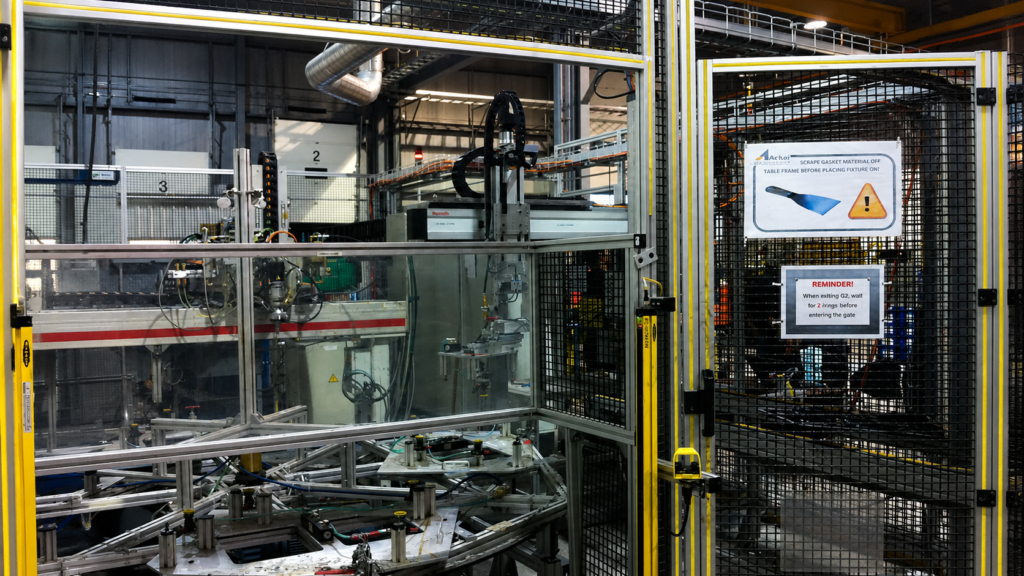
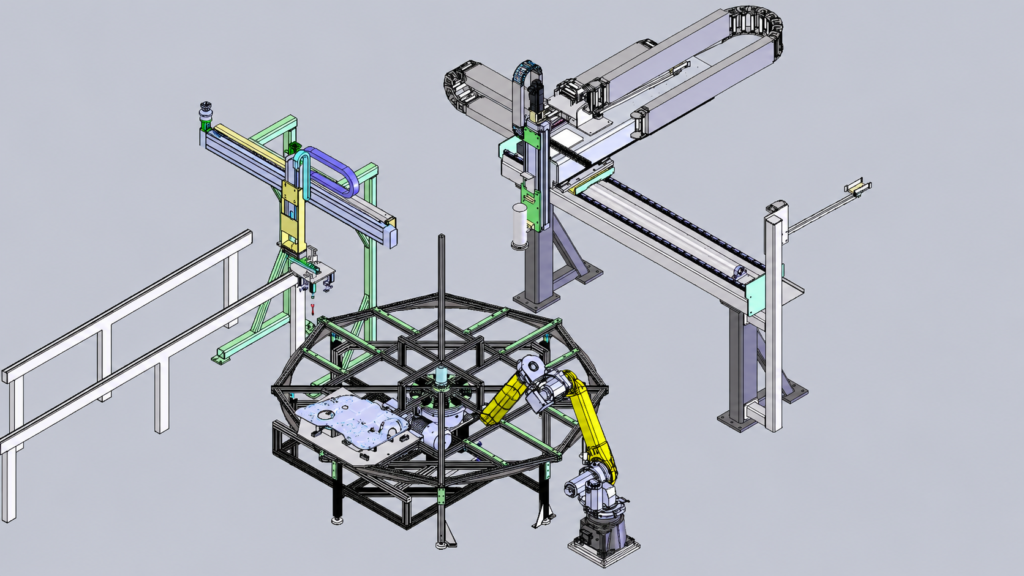
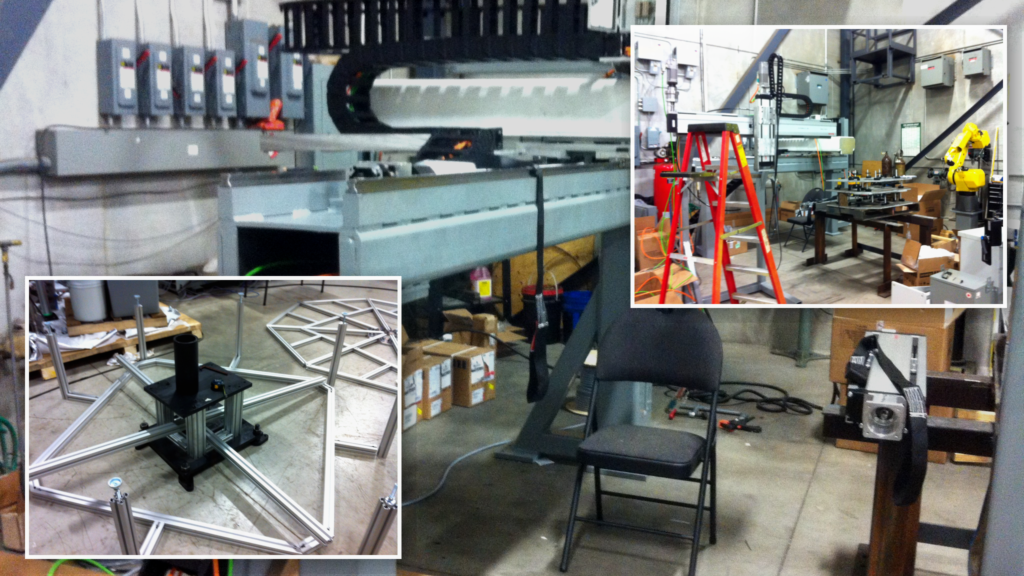
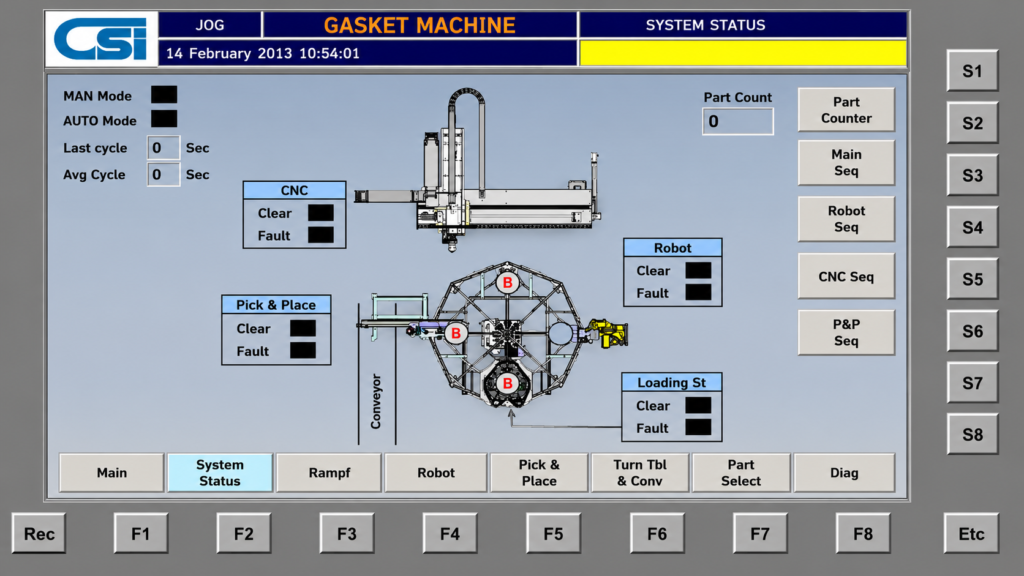
CSI designed and built the complete cell — mechanical structure, controls, electrical, and software — around a four-station rotary dial table. The operator loads a door panel at station one onto a vacuum-fixtured location plate with guide pins. The table indexes to station two where a Fanuc M-20iA robot applies atmospheric plasma using a Tantec system mounted to the robot end-of-arm. At station three, a three-axis CNC gantry dispenses gasket material via the Rampf dispensing system. At station four, a two-axis pick-and-place unloads the finished panel onto a dual-lane drying conveyor that returns parts to the operator.

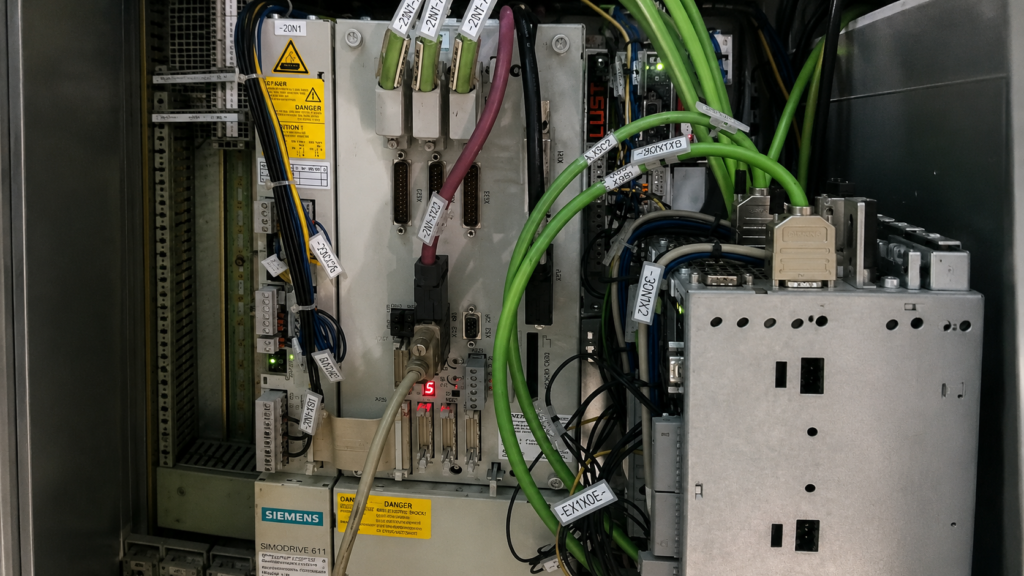
The entire cell runs on a Siemens Sinumerik 840D sl controller with Sinamics S120 drives managing all CNC and pick-and-place servo axes, G120C drives for the dial table and conveyor, and ET200s for digital I/O. CSI integrated the Fanuc robot via hardwired I/O using standard UOP protocol and interfaced with the standalone Rampf controller for dispensing coordination. The HMI provides recipe-based part selection — when an operator selects a door type, all corresponding CNC programs, fixture positions, and pick-and-place recipes load automatically.

The system includes comprehensive diagnostics with sequence status displays for every subsystem (turntable, robot, CNC, pick-and-place), part counters with OK/NOK tracking, automatic rinse cycles triggered by Rampf faults, and mode selection diagnostics that show exactly why a mode can’t be activated.

Key Components

  • Siemens Sinumerik 840D sl with Sinamics S120 drives
  • Fanuc M-20iA robot with R-30iB controller
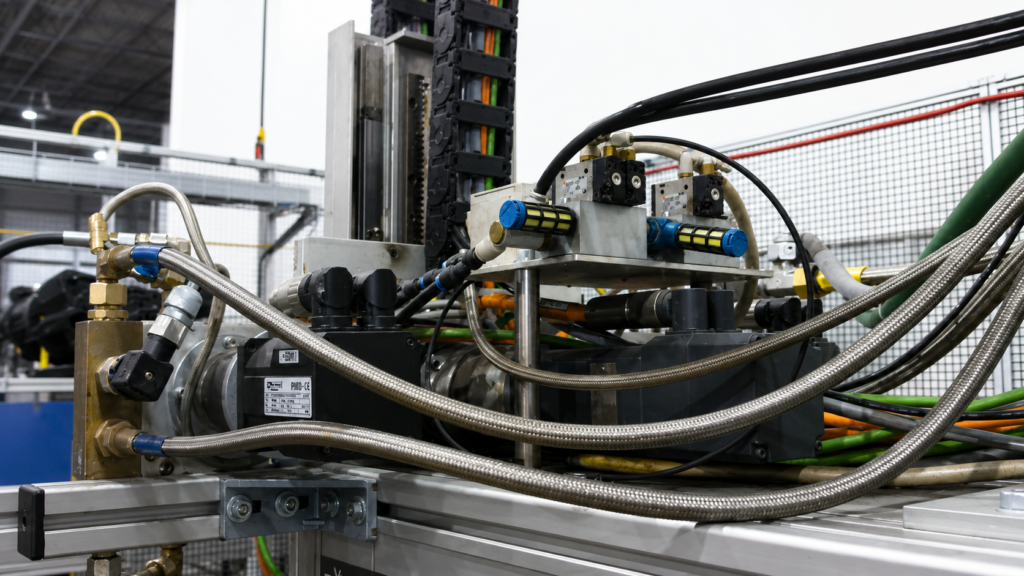
  • 3-axis Bosch ball screw CNC gantry
  • 2-axis servo pick-and-place unloader
  • 4-position indexing dial table with VFD control
  • Tantec atmospheric plasma system
  • Rampf dispensing system integration
  • ESA-approved NEMA 12 control panel

Project Execution

CSI commissioned the system over a six-week period on-site. One of the key technical challenges was G-code generation — the team found that CAD/CAM-generated toolpaths had too many small discrepancies between the CAD model and the actual machine geometry to produce reliable dispensing paths. The solution was to program the dispensing paths via teach pendant, capturing enough reference points to extrapolate accurate toolpaths for each door type. This hands-on approach ultimately delivered more consistent results than automated G-code generation could.

The gasket dispensing formula itself — dialing in the exact chemical mixture for the dispensing liquid — was largely handled by the customer and Rampf, though CSI supported integration testing once the formula was locked in.

The Results

The cell has been running for over 10 years with no significant issues. CSI’s pipelining of the four-station rotary process — where plasma treatment, dispensing, and unloading happen simultaneously on different parts rather than sequentially — brought cycle time down to approximately 12 seconds per part, a major efficiency gain over the previous sequential approach.

~12 sec

Per-part cycle time

10+

Years running

4

Simultaneous operations

Have a similar challenge?

Tell us about your project, and we’ll walk you through how we’d approach it